
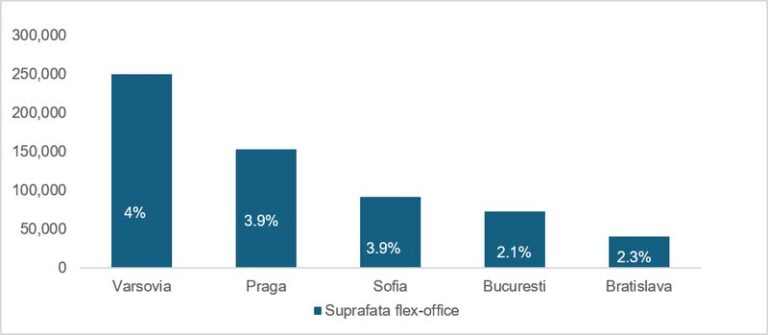
Despite this strong increase over the past decade, Bucharest remains behind several Central and Eastern European capitals when flexible space is measured as a share of total office stock, indicating room for further development in the segment.
Flexible offices account for 2.1% of Bucharest’s office stock, compared with 4% in Warsaw, 3.9% in both Prague and Sofia, and 2.3% in Bratislava. In absolute terms, Warsaw leads with about 250,000 sq. m of flexible workspace, followed by Prague with 153,300 sq. m, Sofia with 92,000 sq. m, Bucharest with 73,500 sq. m, and Bratislava with 40,500 sq. m.
Madalina Cojocaru, Partner, Office Agency, Cushman & Wakefield Echinox: “The growth of this segment reflects a broader shift in the way companies plan their workplace strategies. For occupiers, flexible workspace is no longer seen merely as a solution to temporary needs, but increasingly as a complementary piece of their overall office approach. The ability to accommodate project teams, operate satellite offices or adjust space in line with changing headcount requirements gives firms an extra degree of flexibility. From a landlord’s perspective, having a coworking centre within a building adds a further dimension of choice, allowing tenants to quickly expand or reduce their occupied footprint without having to relocate. As such, coworking can become a competitive advantage for a property, supporting both tenant attraction and retention. At the same time, as the market matures, competition is increasingly shifting beyond price towards the quality of the workspace, services, accessibility and the overall user experience.”
Flexible offices have shifted from a niche offering to a meaningful element of corporate real estate strategies. Market maturity means that mere availability is no longer enough; quality of workspace, connectivity, ancillary services and quick move-in capability are increasingly decisive when selecting flexible solutions.
Analysis of Bucharest’s submarkets shows a concentration of flexible office services in the Center-West area, which hosts 8 centres totaling 16,000 sq. m, or about 21.8% of the city’s flexible stock. The Center area has the highest share of flexible space relative to its total office stock, at 3.2%, with 12 locations totaling 14,500 sq. m.
Other notable submarkets include Floreasca – Barbu Văcărescu with 10,400 sq. m across 7 locations, the CBD with 10,300 sq. m in 8 centres, and Dimitrie Pompeiu with 9,700 sq. m. Supply is markedly lower in other parts of the city: Expozitiei totals 5,300 sq. m, North has 3,100 sq. m across two centres, and Pipera North is served by a single centre with approximately 1,900 sq. m. The West and South areas each have one centre offering 1,300 sq. m and 1,000 sq. m respectively, while the East submarket currently has no coworking locations.
Of the 24 coworking operators active in Bucharest, 62% are local and 38% are international. The four largest players — IWG (via Regus and Spaces), aSpace, HOTSPOT, and Mindspace — together hold 63% of the flexible office stock.
The report highlights growing integration of flexible concepts into landlords’ strategies, with some developments hosting both specialist operators and landlord-managed concepts as complementary leasing tools.
Monthly flexible office rates in Bucharest typically range from about €150 to €450 per desk. Part-time memberships are indicative at €100–€250 per desk per month. A hot desk commonly costs €150–€250 per month, a dedicated desk €200–€450 per month, and private offices €300–€500 per person per month. All figures exclude VAT.
Depending on operator and membership, fees may cover furniture, utilities, internet, cleaning, reception, access to common areas, mail handling and a number of meeting room credits or hours. Parking, extra meeting room time and certain administrative services may incur separate charges.
The supply increase has been accompanied by diversification in product offerings and operating models, from conventional direct leases to turnover-based leases and managed space arrangements, each carrying different investment, occupancy risk and revenue-sharing implications for landlords and operators.