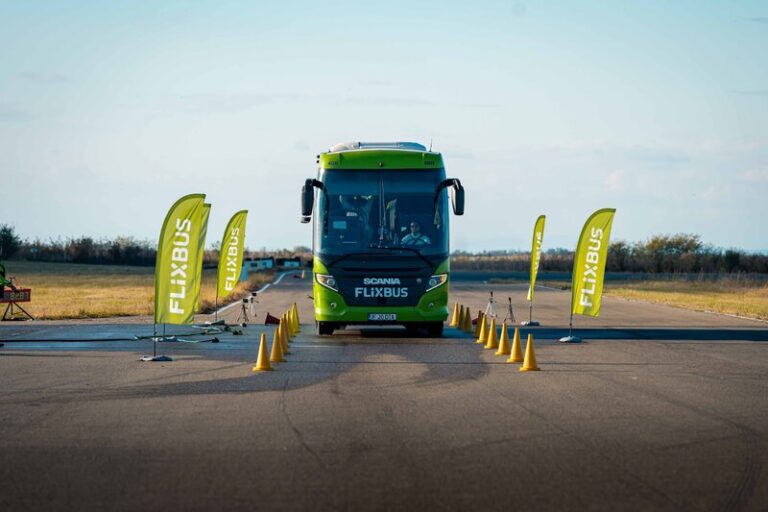
Dozens of coach drivers took part in a defensive driving training on a racetrack, where they practised emergency braking, sudden lane changes and agility courses.
The event was organised by FlixBus, the global travel-tech company that operates the most extensive intercity coach network in Europe. The first edition of FlixBus Drivers Academy in Romania was an event dedicated to coach driver training and road safety. Held at Motor Park România, it brought together 30 drivers who took part in practical defensive driving exercises designed to prepare them for handling unexpected situations in traffic.
From emergency braking to first aid: a day of training on the racetrack
The programme combined theoretical training with practical exercises, giving participants the chance to test their reactions and vehicle behaviour in controlled conditions that are difficult to reproduce in everyday traffic.
Behind the wheel of the coaches, the drivers practised emergency braking on wet asphalt, estimating stopping distances and agility manoeuvres. The programme also included sudden lane-change exercises performed with a passenger car, as well as impact and rollover simulations, first aid workshops and sessions dedicated to road traffic legislation.
“The ability to anticipate risks and react correctly in unexpected situations is essential for road safety. We want drivers never to have to apply in traffic what they practise here, but it is important that they are prepared for any situation. Having built up experience with this programme in other European countries, we are pleased to organise the first edition in Romania as well. Through initiatives like this, we invest in the continuous training of drivers and in the safety of passengers and all road users”, said Adrian Rășoiu, Commercial Director FlixBus Romania.
The drivers practised emergency braking on a wet surface (under 80 km/h) and correct estimation of stopping distances, as well as the agility course, both with the coach. They also practised an emergency lane change on a dry surface (under 80 km/h) with a BMW 230i. The programme was complemented by a first aid workshop, a road traffic legislation workshop and an impact and rollover simulator.
“Behind the wheel of a coach, every decision carries responsibility for passenger safety, and the vehicle’s mass and dimensions make anticipating risks and choosing the right speed and safety distance essential. Training on the racetrack allows drivers to observe, in controlled conditions, how the coach responds to emergency braking on wet asphalt and to better understand the limits of the vehicle they drive. Experience gained in traffic must be complemented by practical exercises, so that the driver can recognise a dangerous situation in time and have well-practised reactions when needed”, said Silviu Toma, founder and defensive driving instructor at Romania Driving Experience.
Road safety starts with continuous training
According to preliminary data published by the European Commission for 2025, Romania is among the countries with the highest road fatality rates in the European Union: 78 deaths per million inhabitants, compared with the European average of 43. In the same year, approximately 19,400 people lost their lives in road accidents in the EU. In this context, prevention and continuous driver training remain essential for improving road safety.
For FlixBus, safety begins before the coach sets off. The company applies a series of measures that go beyond legal requirements, such as using two drivers on almost all night routes in Europe, planning timetables with buffer time for traffic and additional breaks, and regularly checking driving and rest times.
Coaches in the FlixBus network are equipped with modern assistance systems, such as emergency brake assist, lane keeping and adaptive cruise control, increasingly complemented by technologies that detect driver fatigue or inattention. In addition to the mandatory professional training, which includes at least 35 hours of training every five years, Flix organises additional safety training, including in cooperation with external specialists.
“Road safety starts with prevention, compliance with the law and continuous driver training. Modern assistance technologies are important, but they cannot replace the attention and correct reaction of the person behind the wheel. Initiatives such as FlixBus Drivers Academy give drivers the opportunity to practise difficult situations in a controlled environment and contribute to developing a culture of prevention, which is essential for reducing the risk of accidents”, said Cătălin Codescu, President of the Road Accident Victims Association (AVAC).
Another essential element for passenger safety is wearing a seat belt. All FlixBus coaches in Europe are equipped with seat belts, and the company encourages their use throughout the journey through information campaigns, driver announcements and visual materials on board.
FlixBus expanded its network in Romania over the summer
Over the summer, FlixBus significantly expanded its network in Romania, through both new domestic connections and new international routes. Destinations added to the domestic network this summer include Băile Herculane, Orșova, Drobeta-Turnu Severin and Reșița. Iași has also been connected directly with Brașov and Timișoara, as well as with Budapest. On the international side, FlixBus launched the Sibiu–Thessaloniki route, as well as the first direct connections between Romania and Serbia, via the Timișoara–Belgrade and Arad–Belgrade links.
Tickets for FlixBus journeys can be purchased on the FlixBus website or in the app, from more than 1,000 partner travel agencies, as well as at Selfpay points of sale.
Present in Romania since 2017, FlixBus has steadily grown its network and currently connects more than 80 cities in Romania with 16 European countries. Since July 2025, the company has also operated domestic intercity services, connecting more than 80 cities across the country.