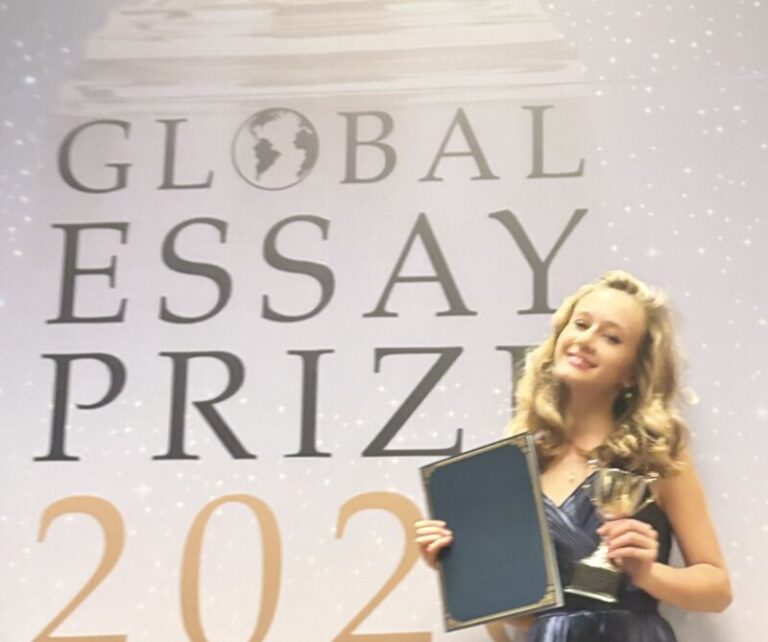
Carola Canale, a student at the International British School of Bucharest, won third prize in the Junior category of Theology with an essay exploring education, faith and values that cannot be measured in monetary terms.
Out of more than 100,000 essays submitted from 183 countries, only three entries reached the podium in each category of the 2026 John Locke Global Essay Prize. Among the award winners was Carola Canale, a 15-year-old Italian-Romanian student in Year 11 at the International British School of Bucharest, who won third prize in the Junior category of Theology.
The awards ceremony took place on 3 October at Grosvenor House in London, as part of one of the international essay competitions for young people organised by the John Locke Institute.
Carola Canale’s essay addresses a complex question at the intersection of religion, education and economics: “Research shows a strong negative correlation between religiosity and per capita spending on education. Is one the cause of the other?”
Her response offers a different perspective on how societies evaluate education and on the role that family, community and faith play in a child’s development.
Education beyond figures and budgets
Starting from the apparent contradiction between religiosity and public spending on education, Carola Canale challenges the assumption that more religious societies place less importance on education. In her analysis, some of the essential activities involved in raising and educating children take place outside the institutions and financial mechanisms captured by official statistics.
Education is not merely about acquiring knowledge in school; it also involves moral development, character formation and the transmission of values from one generation to the next. These processes, the young author argues, make a fundamental contribution to human development, even though they cannot be quantified through budgets or economic indicators.
The essay opens with the African proverb, “It takes a village to raise a child,” which the author uses to illustrate the role of the extended family and the wider community in education. In her view, this form of learning and development represents an alternative to a strictly institutionalised model, yet it remains largely invisible to economic statistics.
“The village was never merely a metaphor. It was an alternative theory of education,” writes Carola Canale.
Three factors explaining the relationship between religion and education
Rather than attributing the relationship between religiosity and education spending to a single cause, the essay proposes an analysis based on three interconnected factors.
The first is economic wealth. Modernisation and rising levels of development can lead both to increased education budgets and to a decline in religious practice. Therefore, part of the observed correlation may be explained by a country's level of economic development.
The second factor is the view of human nature and education. Theological traditions influence how families and communities understand their responsibility for raising and educating children, as well as how that responsibility is shared with state institutions.
The third is reverse causality: religiosity may influence education, but secular education may also contribute to changes in religious belief or to its decline.
Through this approach, Carola highlights the complexity of the relationship between education, society and faith, arguing that financial indicators do not always capture the full value of the educational process.
The cost of increasingly institutionalised education
One of the essay’s central arguments is that higher spending on education does not necessarily reflect, in every case, a greater commitment to children's development. Sometimes, it may also represent the cost of transferring to institutions responsibilities that were previously fulfilled by the extended family and the community.
“There is a profound irony in this triangular dynamic. Highly institutionalised, secular systems that weaken religious communities create precisely the dependency they measure,” Carola argues.
As traditional communities, characterised by close social ties, lose some of their cohesion, families may become increasingly dependent on services and institutions to meet their children's developmental and educational needs. In the author's interpretation, this shift involves not only additional financial costs but also a redistribution of responsibility for a child's development.
The essay therefore raises a fundamental question: what exactly are we measuring when we assess investment in an education system, and how much of education's real value remains beyond the reach of economic indicators?
Carola's conclusion encapsulates the perspective underpinning her entire argument: “If education truly means forming wise and fully developed human beings, rather than producing efficient workers, then the most important investments are precisely those that our financial statistics cannot see.”
From an initial hypothesis to a personal conviction
Beyond the research and the development of her argument, participating in the competition also became an intellectual growth experience for Carola. Initially, the answer to the competition question seemed obvious to her. After weeks of research, however, she began to examine the opposing perspective, and a deeper exploration of the subject led her to a conclusion different from the one she had started with.
In the months that followed, the ideas presented in her essay became more than an academic exercise. During the competition interviews, she found herself defending her arguments as a matter of personal conviction.
“By the end, I was no longer defending an essay. I was defending what I truly believed,” said Carola Canale.
The young student entered the competition confident in her work and hopeful of reaching the final. The award recognises her achievement in a highly competitive international setting and highlights her ability to critically analyse a complex topic, develop a coherent argument and defend her own ideas.
In the closing lines of her essay, Carola returns to the gap between what can be quantified and what gives education its meaning:
“Behind every figure representing school expenditure lies an education that no statistic can see and no budget will ever account for: the formation of the whole human being, the oldest work of faith.”