A 55-square-metre flat, bought with a 15% down payment and a 25-year mortgage, would take 56.3% of the average net salary. After the mortgage payment and a minimum cost-of-living basket, an employee on an average income would be left with EUR 47 a month. The calculation, made by the Institute for Visionary Cities (IOV) and presented at the Affordable Housing Summit Romania, shows where the path to a home breaks down today: not at the asking price, but at what is left of a salary once the mortgage is paid.
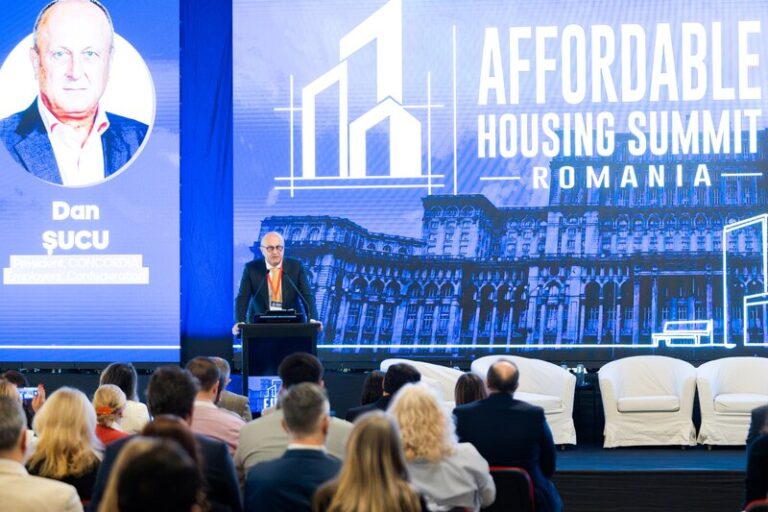
The summit, organised by the Federation of Investors and Developers for a Sustainable Economy (FIDES) together with the Concordia Employers’ Confederation on 5 October, World Habitat Day, at the Palace of the Parliament in Bucharest, brought together more than 200 representatives of European and national institutions, local government, banks, investors and developers. Its conclusions can be summed up in three directions: a national affordable housing programme, adapted to local needs; a functional legislative and financial framework, including for public-private partnerships (PPPs) and real estate investment trusts (REITs); and the creation of a National Affordable Housing Hub and the preparation of the first portfolio of pilot projects.
“We have one of the highest home-ownership rates in Europe, yet four in ten Romanians live in overcrowded homes. Owning a home is not the same as having the home you need. To move from policies to projects, and from projects to homes people can afford, we need a national programme and rules that work, including for public-private partnerships and REITs,” said Constantin Sebeșanu, President of FIDES.
Homeowners, but overcrowded
The data presented at the summit reveal a paradox. In 2025, 93.2% of Romanians lived in a home owned by their household, the second-highest share in the European Union, and 92% lived in a home of their own with no loan on it. At the same time, 40.4% lived in overcrowded homes, against an EU average of 16.8%, the highest rate in the Union. Arrears on rent, mortgage, utility bills or hire purchase doubled in four years, from 9.4% in 2021 to 18.5% in 2025, the steepest increase in the EU.
“Housing is relatively affordable. Financing it is not,” was the conclusion of the presentation by Florian Filat, Executive Director of IOV. The 56.3% payment in the model exceeds the 45% ceiling that the National Bank of Romania allows for a first home. The Colliers presentation by Gabriel Blăniță, Director, Valuation & Advisory Services, Colliers Romania, completed the picture: only 1% of Romanians live in a home with an outstanding mortgage and 7% rent, compared with 27% and 35% respectively in the euro area.
Matthew Baldwin, Head of the European Commission’s Task Force on Housing, took the discussion into economic territory and said that housing is a fundamental right, not a privilege. It is also an issue for the economy and for jobs, including labour mobility, the European official added. Baldwin encouraged Romania to be the first country in the region to launch such a programme.
Concordia brought the employers’ perspective into the equation. Dan Șucu, President of the Concordia Employers’ Confederation, recalled the role of the “Prima Casă” (First Home) programme after the 2009–2011 crisis: “Thanks to this programme, Romania came out of the crisis.” The summit’s conclusions recommend that large employers and employers’ confederations bring hard labour-market data on where housing costs are holding back recruitment and retention, including for teachers, doctors, police officers and other essential workers.
Public money is not enough
Cohesion Policy 2021–2027 supports investment in social and affordable housing worth EUR 500.5 million in EU funds, of which EUR 206.5 million was redirected to the sector through the mid-term review, according to the Ministry of Investments and European Projects. Access to these funds is not automatic: it depends on the rules of each programme, on the eligibility of investments and on well-prepared projects. Dragoș Pîslaru, interim Minister of Investments and European Projects, said that what is really missing in Romania right now is a coordinated vision for the housing sector. The next step, in the minister’s view, is a shift from direct public funding to mechanisms that attract private capital.
Orsolya-Mária Kövér, State Secretary at the Ministry of Development, Public Works and Administration (MDLPA), reached the same conclusion: “We have little money for social housing, so a national housing agency needs to manage all the funds. We must create the right architecture for the right financing of the housing plan.”
“In Romania we are quite lucky: we have specialists, we have financing, but we do not have the main mechanisms for using the money,” said Venera Vlad, Associate Director at the European Bank for Reconstruction and Development (EBRD). The need is greatest in the large cities, she said, and the EBRD is working on this with the Ministry of Development, Public Works and Administration (MDLPA), the Ministry of Investments and European Projects and municipalities.
Rules for private capital
For the investors and developers that FIDES represents, this is the heart of the matter: private capital can build affordable homes only if the rules are stable and predictable. In Romania, public-private partnerships were designed for large infrastructure. Sergiu Manea, CEO of BCR, asked the practical question: how long will it take to adapt them to smaller housing projects?
That is why FIDES supports a public-private partnership framework adapted to housing projects, with risks and benefits clearly allocated and with the impact on the public budget assessed transparently for each model, as well as the adoption, promulgation and implementation of the law on real estate investment companies, currently going through the legislative process in the Chamber of Deputies. REITs could bring long-term capital into rental housing, in a country where renting is still the exception. Where there is public support, however, the beneficiaries, the rents or prices and the duration of affordability obligations must be set from the outset.
A Hub to connect the levels
The summit’s conclusions also describe how the system should work: simple, predictable procedures free of bottlenecks, strong central capacity to coordinate the programme and structure the financing, and technical support for local authorities, so that they can act quickly where their decision is essential.
The piece that connects these levels is a National Affordable Housing Hub. The idea already has a European framework: Matthew Baldwin presented the Commission’s Pan-European Housing Investment Platform, which will work through national financing hubs. At national level, the MDLPA is already working on such a structure. “We are trying to prepare the practical national tools to put this programme in place. For the national housing Hub, we are now building partnerships to form it,” said Orsolya-Mária Kövér.
FIDES proposes that the Hub be set up through a cooperation agreement, with a public coordinator and a technical secretariat, and that public authorities, financing institutions, developers, housing operators, employers’ confederations and civil society be invited to join. Its mandate would be practical: identifying demand and eligible projects, preparing a portfolio of bankable projects and putting forward proposals to remove administrative bottlenecks. A similar initiative launched in France in September is a source of inspiration, not a model to be copied wholesale.
In the period ahead, FIDES will send the summit’s conclusions to participants and partners, invite authorities, financing institutions and other stakeholders to a founding meeting of the Hub and collect concrete project proposals. The Hub’s mandate and first project portfolio will be defined together with the institutions that agree to take part. The Federation is also including the dialogue on the REIT law among its legislative priorities.
“As developers and investors, we also recognise our own responsibility: not only to ask for better policies, but to come forward with proposals and projects that can put them into practice. The value of this summit will be measured by what we build after it,” Constantin Sebeșanu added.
The full conclusions of the summit will be available at federatiafides.eu/summit2026.
The summit was organised by FIDES together with the Concordia Employers’ Confederation, with the support of its institutional partners, the Ministry of Development, Public Works and Administration and the EBRD, its Founding Partner, One United Properties, its sponsors, CEMACON, BCR, Raiffeisen Bank, KPMG and STC Partners, and its content partners, the Institute for Visionary Cities, Colliers and Imobiliare.ro, as well as the Association of Architecture Firms in Romania (ASAR).
The Federation of Investors and Developers for a Sustainable Economy (FIDES) is an employers’ organisation representing real estate developers and related activities. FIDES supports a responsible real estate sector that contributes not only to the national economy but also to quality of life. The Federation brings together developers and investors from all market segments, from housing and offices to industrial facilities and special construction, who believe in collaboration, transparency, ethics and sustainable development.
The Concordia Employers’ Confederation represents 20 of the most important sectors of the Romanian economy and is a nationally representative social dialogue partner. Accounting for 30% of GDP and almost half a million employees in more than 4,200 large and small companies with Romanian and foreign capital, the Concordia Employers’ Confederation is the only organisation in Romania that is a member of BusinessEurope, the International Organisation of Employers (IOE) and Business at OECD (BIAC).
As a representative social partner, we focus on issues of major importance for Romania’s development and prosperity, including the labour market and social dialogue, education, digitalisation, consumer protection, the future of transport, European funds and the circular economy.