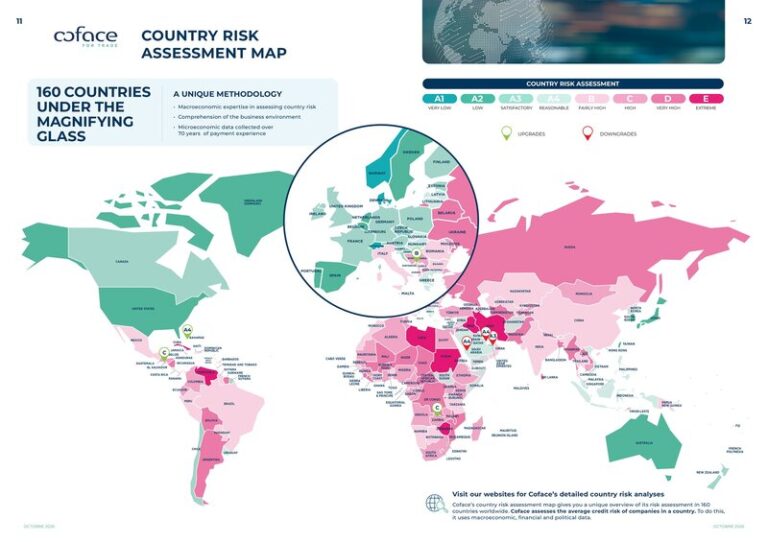
Coface responded by downgrading three countries and upgrading four, while adjusting sector assessments with 12 downgrades and eight upgrades.
0.5 percentage point: estimated cost of the Middle East conflict on global growth in 2026 and 2027
$100/barrel: oil price threshold exceeded in September
2.6%: Coface growth forecast for 2027 (2.5% in 2026)
Renewed hostilities between Iran and the US and the escalation of the conflict between Ukraine and Russia have disrupted supply chains and driven commodity prices sharply higher. Despite increased oil exports through the Strait of Hormuz and rerouted trade flows, hydrocarbon prices have risen by more than 50% for oil and almost 100% for natural gas. Metal prices remain elevated, and agricultural prices surged following strikes on Black Sea port terminals and European heatwaves this summer, with wheat up 40% year-on-year.
These developments have rekindled fears of another inflationary shock, prompting central banks to tighten monetary policy. The Federal Reserve raised rates and matched the ECB with a 25 basis points hike, contributing to tighter global financial conditions. Since mid-January, the US dollar has appreciated by more than 6% in effective terms, while long-term interest rates have risen by over 100 bps across most major currency areas since late February.
So far, global resilience has held, aided notably by AI-related investments and associated wealth effects. Nonetheless, risks are accumulating. Coface retains its forecast of softened activity for 2026 (+2.5%, after +2.8% in 2025) followed by stabilization in 2027 (+2.6%).
Economic activity in Gulf Cooperation Council countries is projected to decline in 2026. Coface downgraded Saudi Arabia (A3 → A4) due to exposure to attacks on energy infrastructure and export routes. The United Arab Emirates (A2 → A3) and Qatar (A3 → A4) were also downgraded because of their dependence on the Strait of Hormuz.
The agri-food sector saw downgrades in six countries. In France, Austria and Poland, the revisions reflect extreme weather in summer 2026. In the United Arab Emirates and Saudi Arabia, vulnerability is linked to heavy reliance on food imports. In Argentina, the sector remains strained by a difficult financial environment with multiple agricultural business failures, high costs and compressed margins.
In the US, household consumption, AI-related investment and a labour market near full employment (with a 4% unemployment rate) underpin resilience.
Europe is faring slightly better than expected, buoyed by the resilience of Germany and Spain, despite ongoing concerns about the sustainability of French public finances.
Momentum across Asia is uneven. Vietnam (+8.4%) and India (+7.5%) benefit from infrastructure spending and AI-related technologies, while China's domestic demand is weakening and some regional economies, notably Thailand and the Philippines, face pressure from rising energy costs.
In Africa and Latin America, the primary risk remains persistently high inflation driven by increasing agricultural and energy prices, exacerbated by the El Niño effect.
"The prolonged conflict in the Middle East is reviving the risk of another global inflation shock. Rising energy, commodity and transport costs are forcing central banks to maintain restrictive monetary policies, which makes the environment increasingly challenging for the most vulnerable governments and businesses." Jean-Christophe Caffet, Chief Economist at Coface
COFACE: FOR TRADE A leading player in global trade credit risk management for 80 years, Coface helps businesses grow their operations and navigate an uncertain and volatile environment. Regardless of their size, location or sector, Coface supports 100,000 clients across nearly 200 markets through a comprehensive range of solutions: credit insurance, information services, debt collection, single-risk insurance, surety bonds and factoring. Every day, Coface draws on its unique expertise and cutting-edge technologies to facilitate trade, both in domestic and export markets. In 2025, Coface had approximately 5,511 employees and recorded a turnover of €1.84 billion.