The October statistics provide a clearer picture of market activity because records for July-September were disrupted by the temporary unavailability of the e-Terra IT system, used for cadastre records and land registry entries, following a cyberattack.
The national rise was driven largely by Bucharest, which accounts for roughly one third of all national transactions. Other counties reporting notable increases included Constanța (+50.4%) and Timiș (+26.6%), each with around 1,000 transactions. By contrast, declines were seen in several significant counties: Ilfov (-10%, about 700 transactions), Cluj (-12.2%, about 800 transactions) and Brașov (-34.3%, under 500 transactions).
„Creșterea numărului de tranzacții în luna octombrie este un semnal încurajator pentru piața imobiliară, în special după perioada marcată de indisponibilitatea temporară a sistemului informatic e-Terra, utilizat pentru evidența cadastrală și înscrierea tranzacțiilor imobiliare în cartea funciară. Totuși, rezultatele trebuie interpretate cu prudență, întrucât o parte din evoluția pozitivă poate reflecta recuperarea unor tranzacții amânate în lunile precedente. Este de remarcat evoluția Bucureștiului, cea mai importantă piață imobiliară din România, care concentrează aproximativ o treime din tranzacțiile realizate la nivel național și unde s-a înregistrat o creștere de aproape 20% față de octombrie anul trecut. În același timp, evoluțiile diferite de la un județ la altul arată că este încă prematur să vorbim despre o revenire generalizată a pieței. Datele din noiembrie și decembrie ne vor arăta mai clar dacă tendința observată în octombrie se va menține”, declared Cătălina Ciorei, Head of Consumer Marketing, OLX Real Estate Europe (Storia și OLX Imobiliare în România).
Between August and October 2026 there were over 41,900 transactions nationwide, a slight decrease of 0.5% versus the same period in 2025. In that interval Bucharest recorded nearly 12,200 transactions, a small fall of 1.5%. Other counties with declines included Ilfov (-1.3%), Cluj (-1.8%) and Brașov (-45%). Conversely, Iași (+11.3%), Constanța (+25%) and Timiș (+40.8%) posted increases over the same months.
In the first 10 months of 2026 the housing market registered almost 113,200 transactions involving individual units, down 15.5% compared with January-October 2025. Bucharest logged about 34,500 transactions (-11.3%). Other reported falls were Ilfov (-11%, 6,700 transactions), Iași (-14.7%, 5,100 transactions), Cluj (-21.5%, 6,400 transactions), Constanța (-22.7%, 6,300 transactions) and Brașov (-32.9%, 4,500 transactions). The only major county with growth was Timiș, with nearly 8,600 transactions, up 6.3%.
In October 7,300 active mortgages were reported, a 1.5% decline from October 2025. Bucharest, however, saw an 11.2% rise to more than 2,300 active mortgages. Smaller increases were recorded in Brașov (+0.8%), Timiș (+8.3%) and Iași (+21.7%), while Cluj (-1.3%), Constanța (-7.6%) and Ilfov (-8.2%) saw decreases.
For August-October 2026 there were almost 23,000 active mortgages, essentially flat year-on-year (+0.2%). Bucharest fell slightly (-1.1%), to just over 6,800 active mortgages. Brașov and Ilfov registered significant drops (-20.7% and -32.7% respectively), whereas Iași (+3.3%), Constanța (+7.8%), Timiș (+20.3%) and Cluj (+39.8%) reported increases.
Across the first 10 months of the year the number of active mortgages reached nearly 64,500, down 15.2% versus the same period in 2025. The capital had almost 19,800 active mortgages (-12.7%). ANCPI's statistics include mortgage refinancing loans, without separate breakdowns.
The National Bank of Romania kept the policy interest rate at 6.5% in its 6 October meeting; this level has not changed since August 2024. The 3-month ROBOR settled around 6.07% after a recent rise, and the IRCC index for loans taken after 1 May 2019 edged up to 5.57% on 1 October, a value applicable until 31 December 2026.
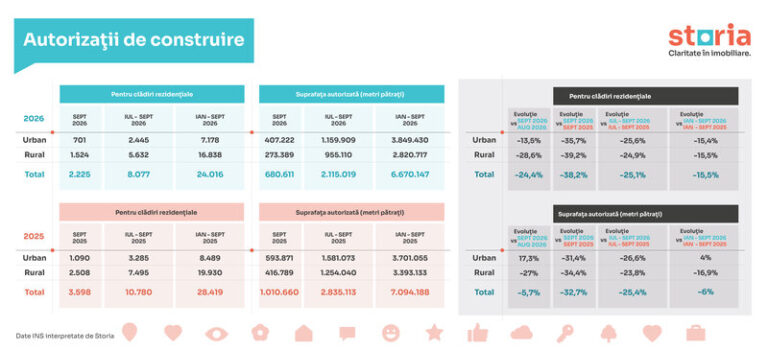
INS data show declines in building permits in September and for the third quarter compared with similar 2025 periods. In September roughly 700 residential projects in urban areas were approved (-35.7%), covering a total area of over 407,000 sqm (-31.4%). Rural areas reported more than 1,500 permits (-39.2%) and an area above 273,000 sqm (-34.4%). Overall in September there were over 2,200 permits (-38.2%) with nearly 681,000 sqm authorized (-32.7%).
In Q3 (July-September) there were more than 2,400 urban permits (-25.6%) and almost 1.16 million sqm (-26.6%). Rural areas recorded about 5,500 permits (-24.9%) and 955,000 sqm (-23.8%). In total there were almost 8,100 permits (-25.1%) and 2.12 million sqm (-25.4%).
Over the first nine months the authorized urban area rose by 4% versus 2025, while the number of projects fell by 15.4% to nearly 7,200. Rural areas saw over 16,800 permits (-15.5%) covering 2.82 million sqm (-16.9%). Overall, in the first nine months a little over 24,000 permits were issued (-15.5%) for a total area of 6.67 million sqm (-6%).
Based on these permits, almost 62,400 dwellings were authorized in the first nine months, 2% fewer than in the same period of 2025. About one third are in the Bucharest-Ilfov region: Bucharest had 10,900 dwellings authorized (+43.6%) and Ilfov almost 10,600 (+15.3%). Growth was also recorded in Cluj (+14.9%) and Constanța (+17.9%), while Timiș (-3.8%), Brașov (-26.4%) and Iași (-46.2%) posted declines.
The National Bank of Romania reported an average euro value of 5.3385 lei in October 2026, up 1.43% from September 2026 (5.2630 lei) and up 4.94% from October 2025 (5.0873 lei).
The statistics cited come from the National Agency for Cadastre and Real Estate Publicity (ANCPI) and the National Institute of Statistics (INS), with the analysis provided by Storia. OLX Real Estate Europe is represented in Romania by Storia and OLX Imobiliare; Cătălina Ciorei is Head of Consumer Marketing for OLX Real Estate Europe.