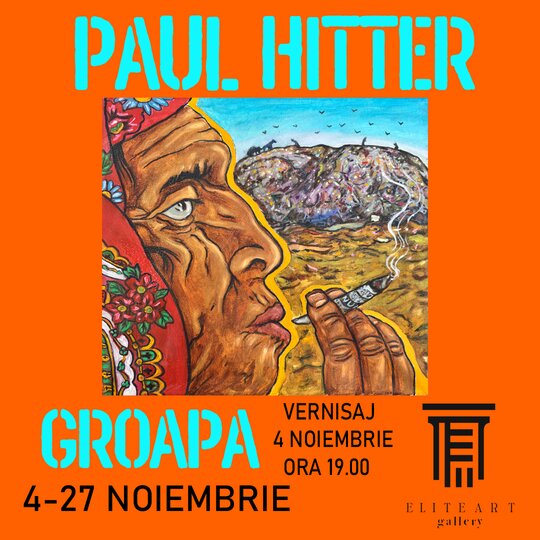
The project’s origin dates back roughly 14 years, when a friend asked Hitter if he had read Groapa. He had not, despite painting with a similar imaginary. After the recommendation, he finished the novel in two days and retained scenes, characters and images recorded in notes that he did not immediately turn into paintings. Over time, what lingered in his memory took visual shape, now presented at the gallery.
Eugen Barbu’s novel reconstructs the Cuțaridei neighborhood on the outskirts of interwar Bucharest with documentary attention to its people, trades, customs, language, relationships and hierarchies. Groapa can be read as a monograph — with the qualities of an epic poem — of a social model: a community closed within its own rules, where poverty, labor, violence, solidarity and individual aspirations coexist at the city’s periphery. Many social mechanisms captured by Barbu — precariousness, hard work, marginalization, power relations and the existence of communities the city prefers to ignore — retain correspondences today, a continuity Paul Hitter acknowledges.
Hitter also draws on memories of the Andronache neighborhood, where he spent part of his childhood. Elements such as the water fountain, mud, the stove, smoke, storerooms, pigeons, carts, roofs, dilapidated houses, garbage and characters from a vanished or transformed world resurface in his paintings as fragments of a personal memory. Barbu’s neighborhood and the one evoked by Hitter remain distinct spaces, yet they meet through recognizable experiences and images.
On the relationship between literature and image, curator Carla Schoppel notes: „Văd «Groapa» ca pe o expoziție despre felul în care o lume literară poate rămâne vie în memoria cuiva până când, la momentul potrivit, își găsește propria formă vizuală. Paul Hitter păstrează lumea lui Eugen Barbu, dar o trece prin propriile amintiri și prin limbajul său pictural. În acest proces, ceea ce părea legat de o anumită epocă începe să vorbească și despre prezent.”
The November 4 opening will be the first opportunity to see how a book read more than a decade ago returns transformed as a series of paintings. The event will also provide a chance to meet the artist; the exhibition does not require prior knowledge of the novel to be understood but may inspire visitors to (re)read it.
Paul Hitter states: „Groapa lui Barbu, acest Macondo autohton, acest loc exotic, este în sufletul meu, dar nu este doar o amintire. Este aici cu noi, în contemporan, trebuie doar să știm să o vedem.”
Paul Hitter (b. 1982) is a Romanian painter and the initiator of Balkan Expressionism. His practice addresses social themes, Balkan popular myths, folklore, legends and urban mythologies. He studied visual arts in Bucharest and Munich and has exhibited in Romania, France, the United States, the Czech Republic, Germany and Italy.