
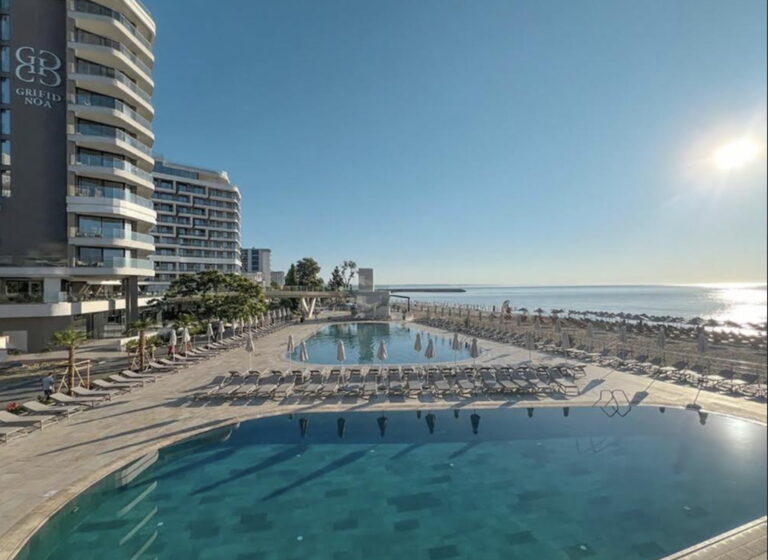
A family of two adults and one child planning a 5-6-night all-inclusive holiday in Bulgaria typically spends between €1,100 - 1,300, according to Travel Planner, Romania's largest online travel platform specializing in holidays to Bulgaria.
Romanians remain the largest group of international tourists visiting Bulgaria, ahead of visitors from Germany, Poland, Greece, the Czech Republic and, as of this year, Ukraine. Between May and October last year, Bulgaria welcomed approximately 2.5 million tourists from EU countries, with Romanians accounting for 31% of the total, according to Bulgaria's National Statistical Institute.
The Bulgarian resorts most popular for Romanian tourists are Golden Sands, Albena, Sunny Beach, St. Constantine and Helena, while Sveti Vlas has gained significant popularity over the past three years thanks to investments in new hotels offering premium services.
Average holiday duration falls to 5.2 nights. Higher marketing investments and greater creativity needed to attract tourists
In 2026, the average holiday in Bulgaria has decreased to 5.2 nights, compared with 5.8 nights in previous years. Travel Planner's management expects the average stay to fall further to 4–5 nights as last-minute offers become available.
Most bookings fall within the €1,100-1,300 range for a family of two adults and one child. During the peak season in June and July, prices start at €350 for two people booking a five-night all-inclusive stay. A family consisting of two adults and one child under the age of 12 pays the same amount, as children under 12 stay free of charge.
On the other hand, the premium holiday segment has been the least affected by the current market slowdown.
"Our partners are reporting a decline of up to 30% this year in the number of Romanian tourists. People are taking more time before purchasing a holiday due to the lack of predictability, which means we have to make a much greater marketing effort. We have increased our digital marketing investment by around 30% compared with 2025, while also becoming more creative and improving both our sales process and website to increase conversion rates. So far, we are up 20% compared to 2025, thanks mainly to early booking sales and especially our Black Friday campaign. However, the tourism market is declining, most likely by a double-digit percentage. Our growth is the result of significantly higher investment and effort than last year. What works today are strong promotional offers, with discounts of 35%, 40% or even 45%. Whenever such offers become available, people book immediately. Ultimately, it all comes down to affordability," said Sebastian Constantinescu, Founder and CEO of Travel Planner.
Travel Planner is an online travel platform founded in 2007 by Sebastian Constantinescu, offering holidays in Bulgaria, Greece and Turkey. Over the years, the company has become highly specialized in holidays to Bulgaria, serving more than 550,000 customers travelling to the neighbouring country during the past 18 years. Last year, the company reported sales of €30 million.
Sales expected to increase through free fuel campaign
One of Travel Planner's main initiatives this year to stimulate holiday bookings is a campaign offering up to 150 tonnes of fuel, including 12,000 fuel vouchers worth RON 100 each and 700 vouchers worth RON 300 each.
"We believe this is a unique concept in Europe, and we expect it to boost holiday bookings, especially after recent international tensions led to a significant contraction in the tourism market. For many Romanians, Bulgaria remains the natural choice because it offers affordable prices, is easily accessible by car, and, through this campaign, travellers can effectively cover their fuel costs," said Sebastian Constantinescu.
Eurostat: Around 60% of Romanians could not afford a one-week holiday in 2025
Although prices have increased by approximately 5–10% compared with 2025, the final prices paid by tourists are broadly similar to last year thanks to special promotional offers introduced by hotels, according to Travel Planner.
"Consumers are much more cautious than they were in 2025. They pay close attention to the value they receive and any additional costs that may arise. Bulgaria's transition to the euro has put pressure on hoteliers and, because occupancy rates are lower, many have an incentive to reduce prices even further. However, rising costs for essential goods limit their ability to do so, which is why we do not expect many spectacular promotional offers. Customers are increasingly hesitant and are waiting for super last-minute deals, but these are relatively rare. Some hotels, for example, are avoiding major discounts because they hope to offset lower Romanian demand with higher numbers of visitors from Ukraine and the Republic of Moldova. Still, whenever discounts of 30–40% do appear, Romanians book very quickly," the Travel Planner founder explained.
According to Eurostat, approximately 61% of Romanians said in 2025 that they could not afford a one-week holiday each year, up three percentage points compared with 2024. This was the highest share in the European Union, compared with the EU average of 27.5%. Other European countries with relatively high shares of residents unable to afford an annual one-week holiday include Turkey and Greece, while Norway, Luxembourg, Sweden, the Netherlands and Denmark have the highest proportions of residents who can afford such a holiday.